I’ve been curious about my left-right imbalance for a while. My Garmin data hints at it, and I can sometimes feel it on longer runs — one side fatigues earlier, the landing doesn’t feel quite the same. Rather than guess, I decided to get a proper running mechanics assessment done by a physiotherapist who could actually measure things.
The value wasn’t just getting filmed on a treadmill. The assessment combined a background interview, lower-limb mobility testing, strength testing with the VALD ForceFrame and Dynamo Plus, and slow-motion treadmill analysis — all in one session. That made the findings much more actionable than a standalone gait video would have been.
How the assessment worked
Five parts in total.
First, a background interview. The physio asked about my training goals, current volume, recent schedule, and how my body had been feeling. This matters because running form changes with fatigue and training phase — you can’t judge it in isolation.
Second, mobility testing. Lying down, checking lower-limb joint range of motion around the ankle, knee, and hip. The goal isn’t just finding what feels tight, but understanding whether certain movement patterns are limited by physical capacity.
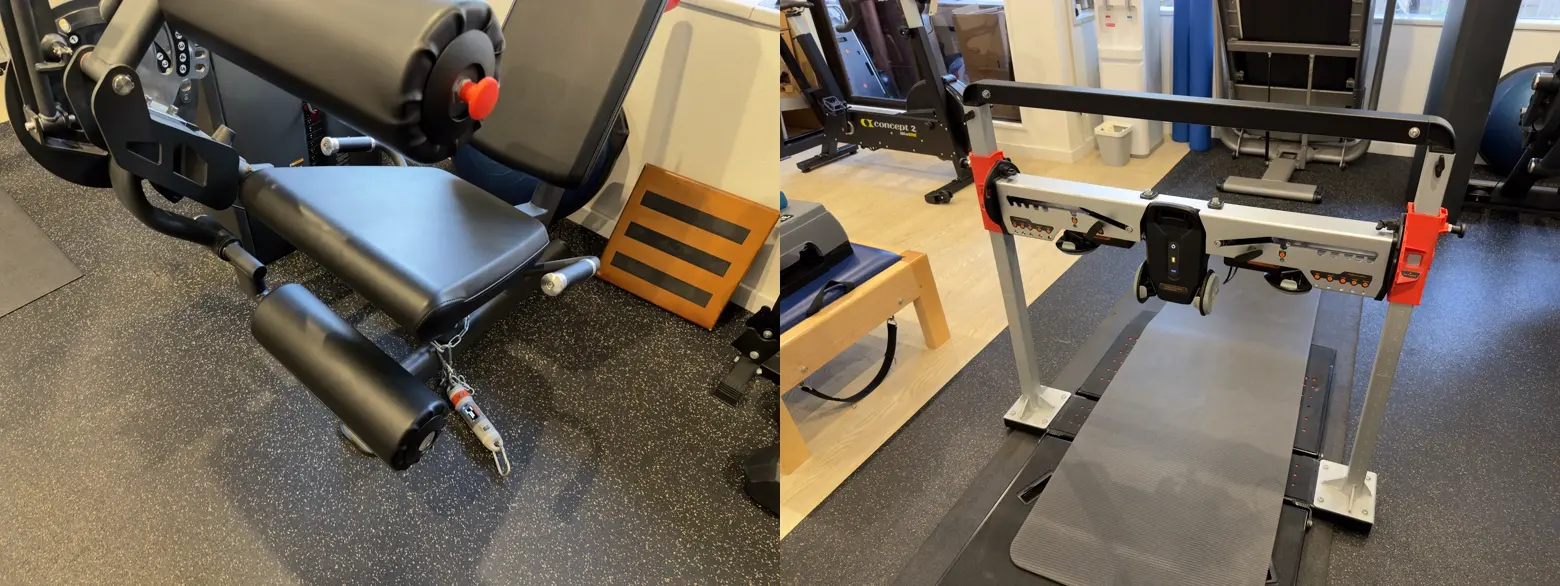
Third, strength testing. Ankle plantar flexion, knee extension, knee flexion, hip abduction, and hip adduction — measured with the VALD ForceFrame and Dynamo Plus. This was the most valuable part for me. It turned a vague impression of “something’s different between sides” into numbers I can track over time.
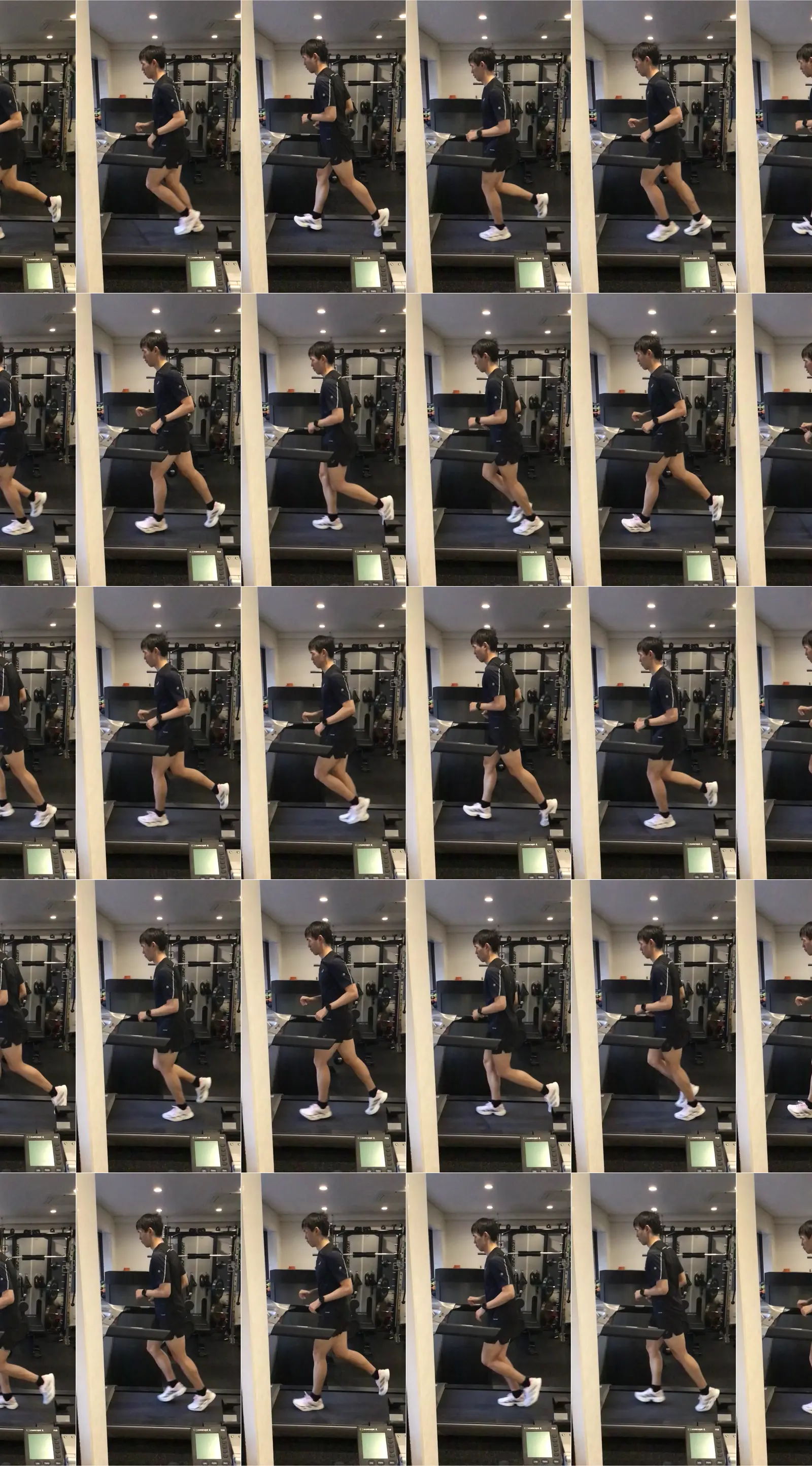
Fourth, slow-motion treadmill analysis. We started at 9.5 km/h as a warm-up pace, then looked at my mechanics again at 11 km/h. Video from both side and rear views, observing landing position, stride length, left-right differences, foot path, and upper-body movement.
Finally, a discussion about training direction based on everything collected. The physio demonstrated part of the recommended exercises and had me try them on the spot.
Main finding: my left side is weaker
The most important result wasn’t about my running form having a visible problem. It was that my left side is relatively weaker.
Running is fundamentally a repeated single-leg support task. Every landing, every impact absorption, every push-off depends on one side doing the work independently. When there’s a strength difference between sides, it affects stability, propulsion efficiency, and movement quality as fatigue builds. Compared to debating foot strike type, left-right symmetry in force production matters more for long-term performance.
This also explains why most of the follow-up exercises prescribed were unilateral. Instead of both legs sharing the load, unilateral work forces the weaker side to carry its own weight. For a runner, that’s not just strength training — it’s building more reliable single-leg support.
No major form issues, but a few details worth noting
From the slow-motion footage, I was mostly landing midfoot. When stride length increased and cadence dropped, I shifted toward a heel strike before rolling forward into propulsion. Not surprising — foot strike isn’t a fixed label; it changes with pace and stride length.
More importantly, there was no obvious overstriding. From the side view, my landing point was roughly under my center of mass rather than way out front. That suggests stride length control and landing position are currently reasonable.
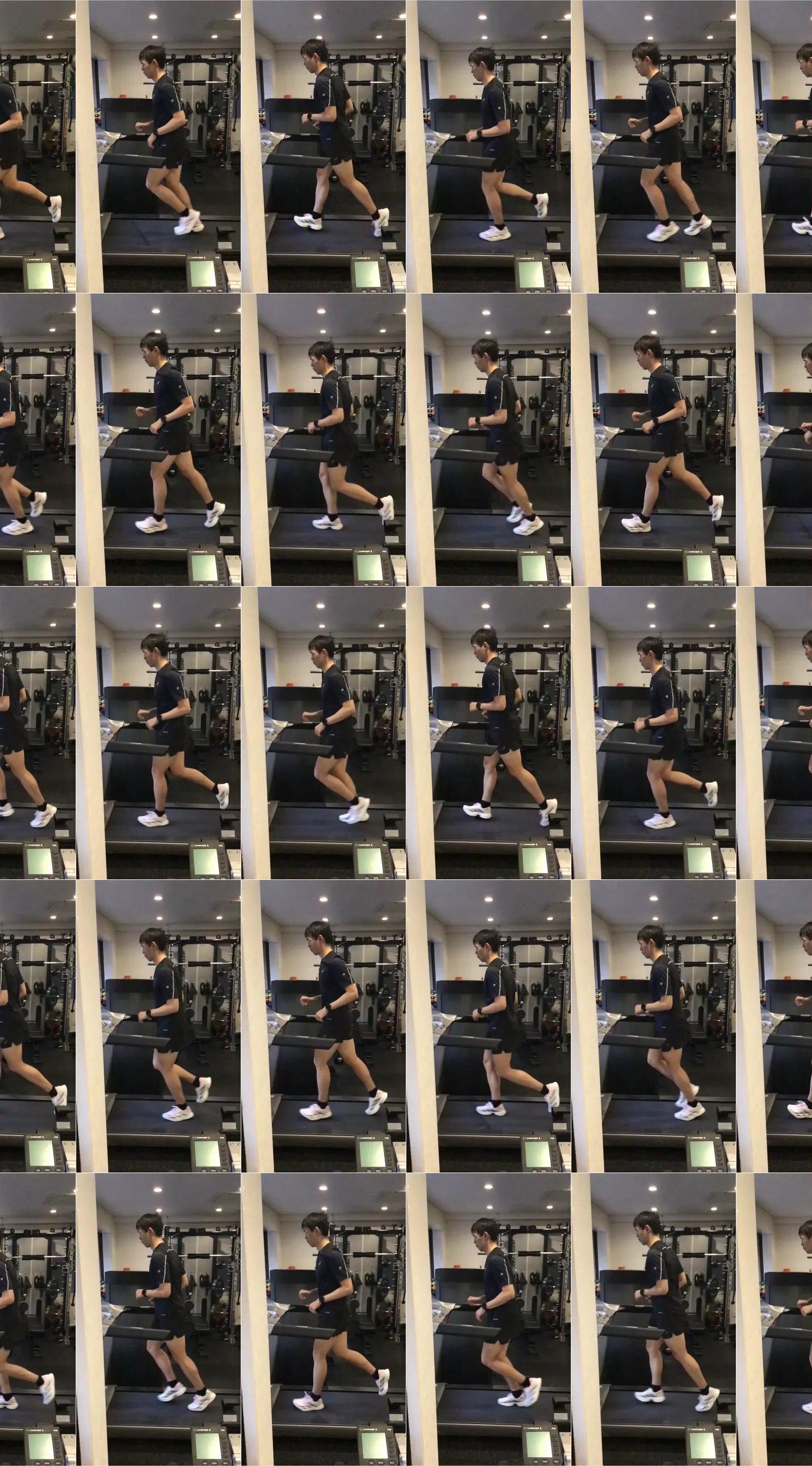
My upper body looked slightly stiff overall. Not a postural error — the position was stable. But there’s room for the upper body to relax more and contribute more effectively. Arm swing, trunk rotation, and trunk stability all affect rhythm and smoothness, even though propulsion comes mainly from the legs.
The physio also noticed mild right-side pronation and a slight toe-out occasionally, but didn’t flag those as major issues. They were small details, not the main finding. A useful reminder: not every quirk in a gait analysis deserves equal attention. Focus stays on what has the biggest effect on stability and function.
Improving capacity matters more than consciously changing form
My biggest takeaway: my running form doesn’t have a major problem, but the left-right strength difference is worth prioritizing.
That’s actually a good result. No obvious overstriding, landing position is reasonable — the basic structure is fine. What needs work isn’t a full form rebuild. It’s the physical capacity underneath the form, especially the strength and control difference between sides. As those improve, movement tends to shift naturally toward better efficiency without forcing it consciously.
This is also why I think this kind of assessment is valuable. Running form discussions tend to fixate on one visible trait — forefoot vs. heel strike, arm swing size, whether the posture looks “correct.” But running mechanics are really a system: mobility determines whether you can do something, strength determines whether you can do it consistently, and form is the final expression of those capacities. Looking only at the outcome without understanding the conditions behind it oversimplifies the problem.
Next step: turning the assessment into training
The most practical part was that the physio directly provided a follow-up strength program based on the findings. The emphasis was clear: not deliberately “fixing” one detail of form, but using unilateral strength work to reduce side-to-side differences and improve support, stability, and control.
That direction makes sense. What’s worth chasing isn’t a form that matches some idealized template. It’s a movement pattern that holds up under training load, stays efficient, and remains relatively stable over time.
If I had to summarize the entire assessment in one sentence: my running form is fine, my left side is weaker, and the next priority is unilateral strength work to close that gap.